 An official website of the United States government


 ) or https:// means you've safely connected to the .mil website. Share sensitive information only on official, secure websites.

CDMRP-Funded Research Develops Deployable Solutions for Critical Care of Warfighters
April 28, 2026
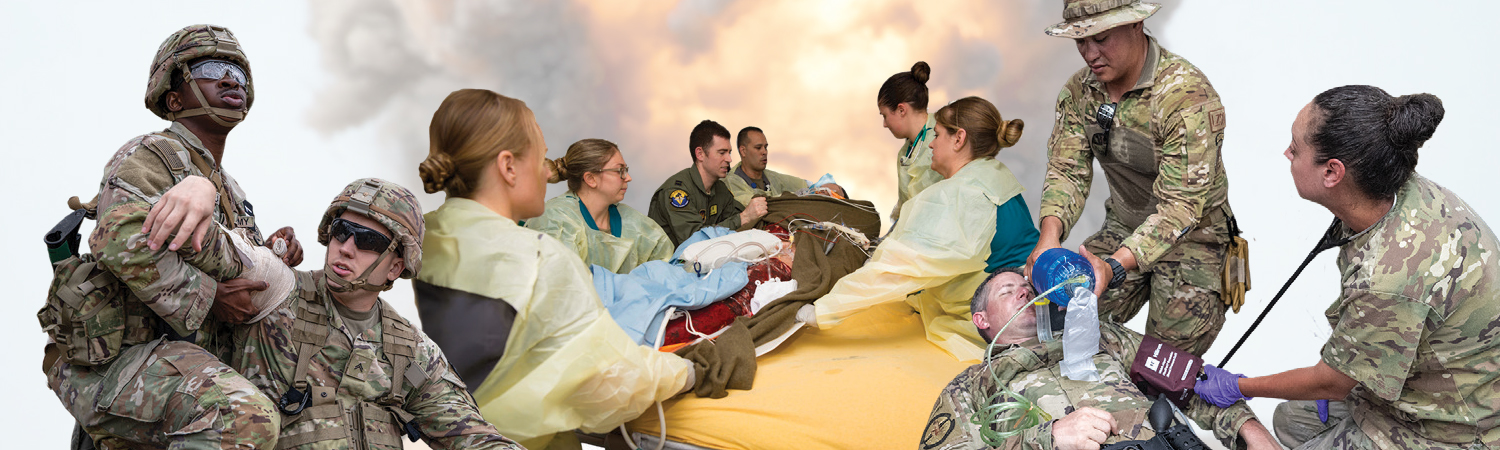
The Congressionally Directed Medical Research Programs fund research to improve the survival and recovery of Service Members with complex battle injuries, including burns and acute lung injuries. These injuries often occur together and can rapidly become life threatening, reducing manpower and resiliency of the force.
Burn injuries account for approximately 5%-20% of wartime casualties. Explosions, vehicle fires and fuel-based weapons can produce severe burns while simultaneously exposing Warfighters to smoke, toxic gases and blast overpressure that damage the lungs. Newly developed medical protocols and technologies can transform diagnosis, treatment and management of burn and lung injuries from point of injury through recovery, increasing survival and accelerating return to duty for injured Service Members.
Portable Technologies Improve Burn Injury Assessment and Treatment
In fiscal year 2017, the Military Burn Research Program funded a Clinical Trial Award, led by Benjamin Levi, M.D., at the University of Texas Southwestern Medical Center, to develop a handheld, point-of-care, camera-based tool to guide burn wound diagnosis and treatment during field care. This tool will aid physical and visual examinations of burns to better determine the depth of the wound and whether the tissue can recover. These factors are important to providing appropriate care, reducing scarring and improving long-term functional outcomes.
"CDMRP funding enabled us to investigate strategies to improve the treatment of severe burn and wound injuries, which remain among the most challenging combat-related injuries," Levi said. "By focusing on scalable, evidence-based solutions, our work aims to enhance immediate stabilization and long-term recovery outcomes for injured Service Members."
Levi and his team incorporated short-wave infrared imaging into the assessment tool, called SWAT for Short-Wave Asessement Tool. Short-wave infrared imaging uses specific sensors to detect light reflected from tissues at low-energy wavelengths invisible to the human eye and poorly absorbed by skin pigments, such as melanin, allowing short-wave infrared light to penetrate deeper into skin than visible light.
In the first human study of short-wave technology for burn depth classification, the researchers found the SWAT successfully differentiated superficial burns from deep burn wounds and identified distinct light reflectance patterns that correlated with tissue biopsies from patients with varying wound depths. Further development of the SWAT will allow non-burn specialists like combat medics and Soldiers to provide adequate care at the point of injury and guide surgeons with the removal of damaged tissue more accurately, reducing unnecessary damage.
"The broader impact of our project extends beyond military medicine," Levi said. "Advances in burn and wound care developed for deployment scenarios often translate directly to civilian trauma systems, disaster response and mass casualty care."
After determining the depth and severity of burns, the wounds may require debridement, or removal of dead tissue to allow the nearby tissue to heal. Additionally, burn wounds are highly susceptible to infection. Preventing burn wound infections in deployed Warfighters presents a unique, time-sensitive challenge. Developing and fielding technologies that enable rapid triage of burn wound depth will help frontline providers prioritize casualties for evacuation, potentially preventing complications such as sepsis.
In fiscal year 2021, the Military Burn Research Program funded an Idea Development Award, led by David Kaplan, Ph.D., at Tufts University, to develop a rapid, field applicable spray for the treatment of burns. The spray coating mimics natural silk spinning, creating a web-like structure to support wound protection, tissue regeneration and infection prevention.
"Support from the CDMRP's Military Burn Research Program plays a critical role in advancing deployment-related care by enabling the development of innovative, clinically translatable solutions that address the unique challenges of burn and wound injuries in austere and resource-limited settings," Kaplan said. "This is important as combat-related burns and wounds to military professionals are associated with delayed evacuation, risk for infections and reduced access to hospitals and advanced treatment options."
In a preclinical study, Kaplan and team demonstrated the effectiveness of the spray, especially when loaded with antibiotics, in accelerating the healing of deep partial thickness burns compared to standard treatments. With additional clinical testing, this spray is a promising option for burn injury care in deployed environments and beyond.
"Advances in biomaterials, especially protein-based systems, offer unique opportunities to design and deliver therapeutics that protect, heal and integrate with the wound microenvironment, superseding other currently available options," Kaplan said.
Respiratory Support Preserves Lung and Body Tissues
Up to 33% of combat casualties develop acute respiratory distress syndrome, a condition in which damaged lung tissues demonstrate reduced capacity to oxygenate blood and remove carbon dioxide. Mechanical ventilation can assist with efficient oxygen exchange for patients with compromised airways, but for those with inflamed or smoke-damaged lungs, the cyclical process of mechanically inflating and deflating the lungs contributes additional inflammation and injury to already injured tissues. Providing protection to the lungs during mechanical ventilation interventions could improve oxygenation and reduce secondary injury, potentially speeding healing and shortening the amount of time patients require ventilation.
With a fiscal year 2019 Clinical Trial Award funded by the Peer Review Medical Research Program, Jeffrey Hasday, M.D., and his team at the University of Maryland are conducting a phase 2b clinical trial evaluating mild cooling of the body to slow metabolism and reduce the body's need for oxygen.
Patients enrolled in the trial, referred to as CHILL or Cooling to Help Injured Lungs, receive mechanical ventilation and, for the first 48 hours of treatment, mild hypothermia to temperatures two-to-three degrees Celsius lower than normal body temperature and a neuromuscular blockade to prevent shivering. The research team anticipates that, compared to mechanical ventilation alone, the cooling treatment will reduce harmful cellular signals contributing to lung injury and increase the number of days free of mechanical ventilation.
As of January 2026, 155 patients enrolled in the study, or nearly 70% of the trial's target enrollment of 226, across 14 clinical sites including military-based trauma and burn centers. The results of this ongoing trial will inform current military clinical practice guidelines for acute respiratory distress syndrome, ultimately leading to more effective care and better recovery for injured Service Members.
While established and potential advances in lung-protective ventilation represent an important step in lung injury care, some patients with severe lung injury or progressive respiratory failure require more advanced treatment. Extracorporeal life support systems are technologies that pump and oxygenate blood outside the body, acting as artificial, external hearts and lungs. These systems are large and heavy, which makes them very difficult to work with, especially in battlefield settings.
In fiscal year 2016, the Peer Review Medical Research Program funded an Investigator-Initiated Research Award, led by Keith Cook, Ph.D., at Carnegie Mellon University, to develop and validate a compact, lightweight pulmonary assist system for providing extracorporeal life support. Cook and institutional collaborator David Skoog, Ph.D., successfully created a prototype device weighing only one-fifth of traditional devices, operational on battery power, and with reduced patient complications, such as clotting or damage to red blood cells.
Through sustained support, the CDMRP is helping to bridge the gap between prototype development and real-world clinical application. In fiscal year 2022, the Peer Reviewed Medical Research Program funded a Technology/Therapeutic Development Award, led by Skoog and with collaboration from Cook, to lay the groundwork for U.S. Food and Drug Administration approval and clinical use of the pulmonary assist system. This includes engaging with the FDA, building a manufacturing line and designing the final version of the device.
"The pulmonary assist system is a platform extracorporeal life support technology with lung support and heart support applications ranging from wounded Warfighter treatment and transport, to interhospital transport in civilian hospitals, to bridging civilian patients to heart and/or lung transplant, to serving as an alternative to lung transplantation for the hundreds of civilians and Veterans that die each year from chronic lung diseases," Skoog said.
Fiscal Year 2026 Opportunities Forthcoming
For fiscal year 2026, the U.S. Congress appropriated $1.27 billion in funding for 34 CDMRP research programs, including the Military Burn and Peer Review Medical Research Programs, to support research to improve deployment-related medical care of Warfighters and the lives of Service Members, their Families, Veterans and the American public.
To receive updates regarding fiscal year 2026 funding opportunity announcements, please subscribe to email notifications through the electronic Biomedical Research Application Portal. You can also visit the homepage of the CDMRP website for updates and other organizational publications and news releases.
Last updated Wednesday, August 12, 2026