 An official website of the United States government


 ) or https:// means you've safely connected to the .mil website. Share sensitive information only on official, secure websites.

Alzheimer's
Posted September 29, 2025
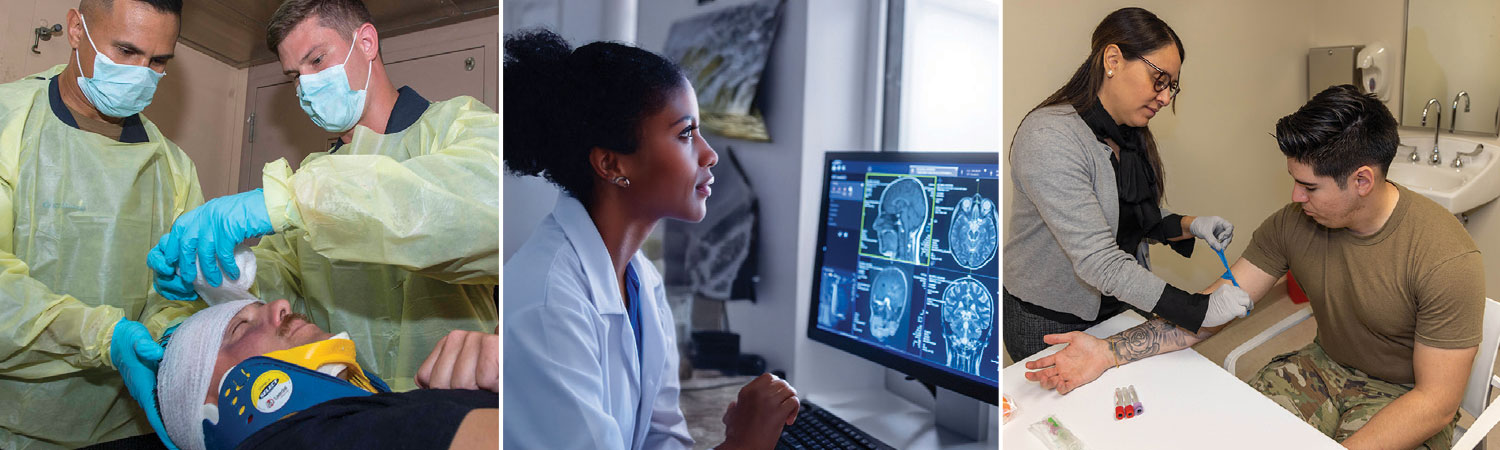
The Alzheimer's Research Program prioritizes identification and reducing the impact of risk factors that increase the likelihood of Alzheimer's disease and related dementias, particularly those affecting military personnel. One military-related risk factor is traumatic brain injury, which increases lifetime dementia risk by 66 percent. Veterans with a history of TBI are twice as likely to develop dementia compared to members of the general population.
To improve early detection of thinking, memory and brain cell changes associated with Alzheimer's and dementia, especially in Service Members, Veterans and other civilians who experience head traumas, the AZRP funds research into biomarker identification and advanced analytical techniques like machine learning.
Alzheimer's disease, the most common form of dementia, affects more than an estimated six million Americans aged 65 and older. The disease damages brain cells, primarily neurons, which impairs an individual's memory and ability to think, known as cognitive function. Alzheimer's disease and dementia also impact behaviors and mood, eventually inhibiting the ability to complete everyday tasks.
"A major military and public health concern is the long-term effects of TBI leading to Alzheimer's disease and related neurodegenerative pathologies," David Okonkwo, M.D., Ph.D., who led a fiscal year 2017 AZRP Research Partnership Award project, said. "The CDMRP Alzheimer's Research Program has delivered critical insights and centered the field specifically on the brain health implications of military service."
Potential Biomarkers for Early Detection of Neurodegeneration
With the Research Partnership Award, Okonkwo and co-investigator James Mountz, M.D., Ph.D., at the University of Pittsburgh, identified trauma-related biomarkers of cognitive decline by comparing brain images and blood and behavioral assessments from Veterans with TBI to healthy civilians.
"Brain health is central to quality of life and longevity; yet, we have not achieved effective and durable treatments for neurodegenerative disorders," Okonkwo said. "Alzheimer's disease is perhaps the most vexing neurological disorder, with profound societal implications."
Okonkwo, Mountz and their research teams discovered early changes in brain regions responsible for emotion and memory occurring after a TBI that could predict behavioral and cognitive issues later in life.
The team also identified elevated levels of several Alzheimer's disease and dementia biomarkers in blood samples from Veterans with a history of TBI. These findings helped establish new clinical guidelines and recommendations for the use of blood-based biomarkers to predict long-term risk of TBI consequences, including Alzheimer's disease and related dementias.
Identification of TBI-Related Alzheimer's and Related Dementia Risk
In fiscal year 2019, the AZRP funded a Convergence Science Research Award, led by Igor Akushevich, Ph.D., and his team at Duke University, to detect patterns in medical histories and patient behaviors for identifying high- and low-risk populations for onset of Alzheimer's disease.
Using clinical data, including history of TBI, from thousands of Veterans and other civilians living with Alzheimer's disease or a related dementia and from healthy controls, the research team developed a mathematical forecasting model to predict risk for developing dementia. The model demonstrated a strong relationship between TBI, psychosocial symptoms and cardiovascular health and increased Alzheimer's and dementia risk over an individual's lifespan.
According to Akushevich, novel computational tools that help track and respond to changes in health over time will improve care at every stage of Alzheimer's disease progression.
"New approaches for modeling Alzheimer's disease dynamics at individual and population levels, possibly involving the methods of machine learning and artificial intelligence, would provide for more personalized health care, reduce stress for families and improve the quality of life for people living with dementia," Akushevich said.
Machine Learning Drives Future Directions for Alzheimer's Research
With a fiscal year 2023 Transforming Diagnosis Award to the University of Kansas Medical Center, Jennifer Villwock, M.D., and her team are studying multisensory dysfunction, a condition that causes difficulties in hearing, balance and smell, and its impacts on memory and thinking.
Villwock's team plans to enroll Veterans and other civilians and track their health outcomes over time. Using machine learning algorithms to analyze clinical records, the researchers aim to describe the relationship between TBI severity, multisensory dysfunction and cognitive decline and to develop a predictive algorithm of future brain health, including potential risk for Alzheimer's disease and other related dementias.
If successful, this study could provide one of the first comprehensive predictive models to incorporate early multisensory decline, only recently identified as a risk factor for Alzheimer's and related dementias.
"It is important to understand how sensory performance is impacted by TBI," Villwock said. "For example, a particular multisensory dysfunction may be concerning for Alzheimer's disease in the general population but be considered within the realm of normal for a Veteran who has experienced a moderate TBI. Understanding these nuances is critical to advancing TBI and dementia care and outcomes."
Villwock's ongoing study could enable earlier identification of individuals likely to face long-term challenges with memory, cognitive functions and sensory processing after TBI. This knowledge may allow medical professionals to intervene earlier and prevent or slow future cognitive decline.
For Villwock, her career's work researching Alzheimer's disease is deeply personal.
"My own grandmother does not know who I am anymore," Villwock said. "I want to work towards a future where not only lifespan but, more importantly, 'wellspan' is maximized. My overarching professional goal - whether it's the research I pursue or the clinical care I deliver - is to help people experience vibrant, healthy and fulfilling lives."
Advancing Research for All Individuals Impacted by Alzheimer's and Related Dementias
The AZRP funds impactful, solution-oriented research to address critical needs and improve quality of life for Service Members, Veterans, their Families and the public who are living with Alzheimer's disease and related dementias.
For more information about the AZRP, visit https://cdmrp.health.mil/azrp/default.aspx.